THE FOUNDATION
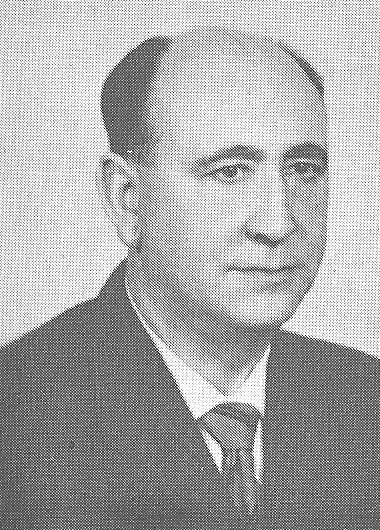
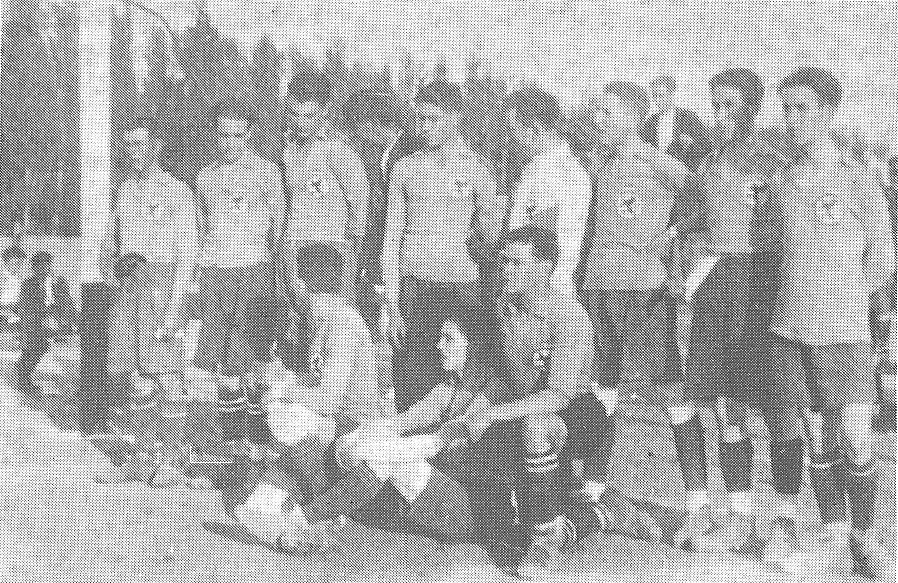
Pereira in goal.
And so, from the goalposts, we begin this culturalist story.
It was May 1923. And Fernando Balbuena Pereira recalls it like this…
“La Cultural began its football journey with a different kit from today: grey shirt, blue shorts with a white stripe…”.
And we move on to remember —in the style of the publications of the time— testimonies of the Foundation.
LA CULTURAL Y DEPORTIVA LEONESA was founded in May 1923. The León team was formed from the merger of Club Victoria and Gimnástica, with the initiative led and promoted by journalist Carmelo Hernández Moros. La Cultural Leonesa made its debut on 5 August that same year, beating Club La Salle from Palencia by three goals to nil.
The first president was Mr Miguel Canseco and the club was born as a “cultural, artistic, recreational and… sporting” initiative.
“Well — recounts Pereira, the first goalkeeper — it was a political consequence. You see: it was the time of Primo de Rivera and in the Cortes (which were not called that then) there was the National Assembly. To gain an ‘act’ you needed to preside over a cultural society. That was how you began your political path and reached that platform. Canseco spoke with several people (notably with the support of journalist Carmelo Hernández, ‘Lamparilla’), and the club was founded which, besides football, dabbled in the arts, encouraged excursions, sponsored lectures, organised a choir…”.
From that era —and according to the archives— it is worth highlighting the Augustinian Father Ambrosio, the Del Río brothers, the Hurtado, Merino, Belinchón, Reguera, Crespo, Oria, Mariano Andrés. And the sports section quickly gained special momentum.
At that time —continues Fernando Balbuena Pereira, Pereira by sporting name— matches were played at the “El Parque” field. And Miguel Canseco, a splendid man, a great Leonese, secured the lease of a plot of land. We already had a “stadium”. And the President, out of his own pocket, ordered the installation of fences, wooden benches and a
stand for authorities and directors. But naturally, we were among family…
Pereira recalls that… “we switched to today’s kit —white shirt and shorts— as we could not find those strange grey shirts…” and he tells us a curious anecdote about the first culturalist leader:
“Look. He didn’t understand anything about football. On 17 August (1923) the presentation match was to be played. The team was already on the field in what is now known as ‘passing around’ or ‘warm-up’ when Canseco appeared accompanied by Julio Crespo, who was the club secretary. He came up to me and looked at me carefully… then at the goal. He hesitated and, addressing the secretary, said: ‘I think you have made these goals too big for Pepe’s boy.’ (Pepe was my father and a great friend of Canseco). He was told that all goals were the same size and were marked by
a Regulation. He only added: ‘Well, what a regulation!’ This already gives an idea of his ignorance of football”.
Pereira now talks about the line-ups of 1923:
“Pereira (that is, me); Manolo and Argüello I, defenders; midfielders Argüello II, Larraz and Camilo; and forwards Gordón, Azcárate, Menéndez, Aller and Ardilla. It didn’t last long. Azcárate and I went to study in Madrid. I, for example, only played in six matches…”.
The report leads us to an assessment of those first culturalist heroes…
The star of the team, says Pereira, was Azcárate. I saw him play later in a student residence team in Madrid. Pedro Crespo was also very good… If I had to highlight one from the whole history (almost prehistory), I would choose Colinas…
And what did a goalkeeper like Pereira earn then?
“I earned… bruises. And it cost you money. Back then you didn’t pay to watch football. To sit down, yes. We rented chairs from Graciano and then charged a peseta per seat. Everyone else was standing or on benches. And as members, we had fifty enthusiasts. The President covered all expenses, and each of us bore our own costs. From buying lime to paint the field, to painting it. And in summer we played ‘bowls’. We played at festivals in Cistierna, Boñar. They took us as the main ‘attraction’, like a circus.
As a goalkeeper, you had your share of joys and sorrows.
“Yes indeed. Many ‘silly’ goals were scored against me. The ‘champion of all silly goals’ was scored by the Asturian selection. Let me see, fifteen days after the debut —against La Salle of Palencia, and with a victory— we faced an Asturian selection returning from a tour abroad (Mexico, Central America, etc.) and they scored seven goals on me. We lost seven to one. And one of those goals… the silly one. My trousers fell down (Meyba hadn’t been invented yet) and I spent the whole match more worried about the band holding my shorts than the ball, and at one point the forward appeared. It was one or the other, the ball in the net or the trousers down, and the first happened”.
And in those days of “those crazy people with their crazy balls”, there was no tactics, no concentration, no miracle water…
“Nothing, nothing, no massages, no concentration. But we did have warm-up. Of course! We painted the field ourselves. It was marked in the morning. A lady from La Corredera lent us the watering can and water. We made the ‘whitewash’ and marked the field!
We ended up with our kidneys broken. Concentration? Yes, yes. I went to pick up Azcárate on a motorcycle with sidecar from his estate in Villimer, and if you weren’t careful you’d arrive at match time but not at lunchtime.”
What other eras can you tell us about?
“I remember a team called ‘El Once Leonés’. They played near the Hostal, where the petrol station is now. It was a good team, the Páramo brothers, who were from Cavalry and excelled at football; Belinchón who played very well; Santiaguito, the goalkeeper; Isaac Bayón who came from Galicia…; I also remember when the Guzmán field was where ‘La Voz de León’ is now, and great players like Benjamín, Cayetano, Colinas…” Fernando Balbuena Pereira, Pereira to the fans of the early days, continued in football.
“I was with Antonio Amilivia. In his time we achieved promotion to the first division, and in three years. An amazing Board of Directors. I also recall with emotion the Board presided over by Ricardo Hermosilla (RIP), a gentleman and a promoter of all things Leonese. He always told me to advise him…, football was not his thing. True, he wasn’t a football technician but he was a great businessman, he had the precise vision to lead a club. I also remember those men —Alfredo Cadórniga, mayor, and Barquero, governor— who not only pushed for promotion but made possible the construction of the stadium which, by the way, was not completed in its entirety.”
Fernando Balbuena has other achievements to his name.
“After La Cultural I played for Atlético de Madrid and was Spanish rugby champion with the Colchonero club”.